Do you wig out in the warm up?
A recent discussion with a Discovery Aquatics athlete led to this post. The discussion goal was to pinpoint the cause of nervousness or anxiety getting into the pool and during the first few minutes of swimming. She describes the feeling as ‘impending doom’ lurking over her as she gets in the water and begins swimming.
Once we had talked about what was happening physiologically during this time, we were able to connect her emotional response to the sensations and then develop some strategies to make the transition from deck doom to swimming success. Here is a summary of our discussion.
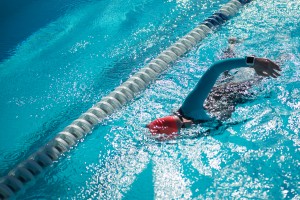
Humans are a finely tuned and balanced organization of complex systems. Broadly speaking and in relevance to this discussion, the brain and nervous system, cardiovascular system, respiratory system, endocrine system, musculoskeletal system and energy systems are all working together to maintain harmony. This harmony is particularly disrupted when you begin exercise, going from inactivity to activity, creating demands on the body and on the organization of these systems. These complex systems function to meet the demands of the increased workload of exercise which, broadly speaking, is the delivery of nutrients and oxygen, and the removal of waste and heat.
One waste product, carbon dioxide (CO2), can create some unpleasant sensations during the first minutes of exercise. During this time, a huge increase in demands on the body is occurring and matched by an increase in CO2 production. CO2 is harmful to the human body and the body works hard to transport it to the lungs where it is exhaled and exchanged for oxygen.
It is fascinating to look at how the body knows CO2 is on the rise. When CO2 rises, the pH of the blood changes. It becomes more acidic. There are special receptors located in the brain and heart that are sensitive to pH. When these receptors sense a deviation from normal balance and harmonious conditions, the lungs are stimulated to increase breathing rate and volume, with the end goal to remove the CO2.
This is a wonderful system. On land. Where you can easily allow the increased rate and depth of breathing to occur.
How about when you are swimming freestyle? The moment to inhale oxygen is brief and delicately timed. Finding a harmonious exchange of CO2 for O2 can be challenging for many, even once the body has adjusted to the increased workload. The first few minutes create extra challenges with the steep rise of CO2 and lack of freedom to breathe in when you would like.
This sensation of not being able to regulate the amounts of CO2 and O2 can lead to panic, fear, anxiety and in this case ‘impending doom’.
Here are some strategies we discussed to help the body adjust to the initial CO2 rise that occurs during the first few minutes of swimming:
- warm up on land to get the gas exchange happening in an environment where you can breathe in and out as you like – light jog, elliptical, dynamic stretching, stationary bike
- make your warm up swim pace easy and comfortable, ease into your practice
- keep exhalation soft and gentle through mouth and nose, sense if you are holding breath, release it
- breathe more often during the warm up – perhaps every 2nd stroke to your favorite side
- use a swim snorkel during warm up until you are confident to try without
- learn about your reaction to unpleasant sensations, acknowledge and accept, try not to react
Giving this athlete the understanding of what is happening during her warm up has been a wonderful light bulb moment for her:
‘You said something in Tuesday’s swim instruction that helped me out a bunch: “feel the co2 build up as you begin moving, accept it, release it gently”. This has been something I fight during the first 100 and I didn’t know what it was before. It’s like a feeling of impending doom for me. And, after about 100 or 150 it goes away. Thank you! Now I know what I’ve been feeling!’
Coach Dinah

 January 27, 2015 10:52 am