Faster strokes – What is the return on that investment?
Moving your body faster when swimming freestyle does not necessarily equate to a faster swim speed.
The reason is simple. There are two stars of the show when it comes to pace or speed.
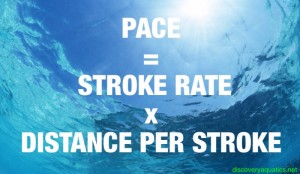
Pace or speed depends not only on your stroke rate (how long it takes you to swim each stroke) but also the distance covered with every stroke (how far you travel with each stroke).
When you swim sets striving to get faster it is important to consider both stars of the show. This was highlighted recently with a remote swimmer who sends data occasionally to track progress. He had collected times and stroke counts from a series of 100s, performed at 1.2 mile race pace in September 2014 and February 2015. The first (and often only) data point swimmers look at is pace or speed. Fair enough, we all want to be faster.
| Workout Date |
100 Yard Pace (mm:ss) |
|---|---|
| September 2014 | 01:32 |
| February 2015 | 01:31 |
The numbers show a one second per 100 improvement. Making any kind of assessment here with just one data point is not very meaningful. Pace is an outcome, it would be wise to look at the next data point, stroke count, to understand how he swam the 100s.
| Workout Date |
100 Yard Pace (mm:ss) |
100 Yard Stroke Count |
|---|---|---|
| September 2014 | 01:32 | 69 |
| February 2015 | 01:31 | 79 |
More data, more information, more sense, better judgment. From this data stroke rate can be calculated. It is obvious from the 10 stroke count difference that he swam each assessment at a different stroke rate.
| Workout Date |
100 Yard Pace (mm:ss) |
100 Yard Stroke Count |
100 Yard Stroke Rate (s) |
|---|---|---|---|
| September 2014 | 01:32 | 69 | 1.14 |
| February 2015 | 01:31 | 79 | 1.00 |
Now we have information that tells us how he swam each assessment. Process data brings meaning to the numbers. By swimming the recent set taking faster strokes (it may feel like you are going faster) we see the speed gain of only 1 second per 100, and an addition of 10 strokes. The impact of randomly making your strokes faster is often a significant loss of stroke length. As we stroke faster, we need to prioritize drag reduction and timing precision to sustain stroke length.
If we extend the process data to a 1.2 mile swim we learn some more:
| Workout Date |
100 Yard Pace (mm:ss) |
100 Yard Stroke Count |
100 Yard Stroke Rate (s) |
1.2 Mile Time (mm:ss) |
|---|---|---|---|---|
| September 2014 | 01:32 | 69 | 1.14 | 32:23 |
| February 2015 | 01:31 | 79 | 1.00 | 32:02 |
If he chose to swim at the recent combination of stroke length and stroke rate he would be 21 seconds faster than the September data. But at what cost? And is the increased stroke rate of February sustainable over 1.2 miles?
| Workout Date |
100 Yard Pace (mm:ss) |
100 Yard Stroke Count |
100 Yard Stroke Rate (s) |
1.2 Mile Time (mm:ss) |
1.2 Mile Stroke Count |
|---|---|---|---|---|---|
| September 2014 | 01:32 | 69 | 1.14 | 32:23 | 1457 |
| February 2015 | 01:31 | 79 | 1.00 | 32:02 | 1668 |
To achieve the 21 second time improvement, he would have to swim an extra 200 or so strokes. That’s a lot of extra strokes for 21 seconds. Are they worth it? Is the energy consumed best spent here? Or swim at a slightly slower stroke rate, bank the 21 seconds and the energy of 200 strokes and spend it later on the bike or during the run.
Looking forward to his next set of assessment 100s, there are some options he could consider to better spend his energy and gain speed. Using the Finis Tempo Trainer he could try a stroke rate of 1.10 seconds per stroke and sustain stroke length to gain speed. After he has accomplished that, he may try to drop 1 stroke per 100 yards and become even faster.
| Workout Date |
100 Yard Pace (mm:ss) |
100 Yard Stroke Count |
100 Yard Stroke Rate (s) |
1.2 Mile Time (mm:ss) |
1.2 Mile Stroke Count |
|---|---|---|---|---|---|
| September 2014 | 01:32 | 69 | 1.14 | 32:23 | 1457 |
| February 2015 | 01:31 | 79 | 1.00 | 32:02 | 1668 |
| Option 1 | 01:29 | 69 | 1.10 | 31:21 | 1457 |
| Option 2 | 01:28 | 68 | 1.10 | 30:58 | 1436 |
By managing process data, we can optimize outcomes, improve pace and ensure we are getting return on our investment.
Coach Dinah

 March 12, 2015 3:39 pm |