Adam was in the studio this week for a tune up lesson. As usual the first order of business is to take video and have a look at his swim. We also discussed his current thoughts about his swimming, any plateau points and discoveries that he has had since we last met. He had raced in a sprint tri a few days prior and was not able to find a comparable open water pace to what he can swim in the pool.
During his time at the studio we identified three main areas for him to generate some speed. One focal point in particular had the potential to contribute to speed gains in a few different ways. Here is a look at a screenshot of what we saw.
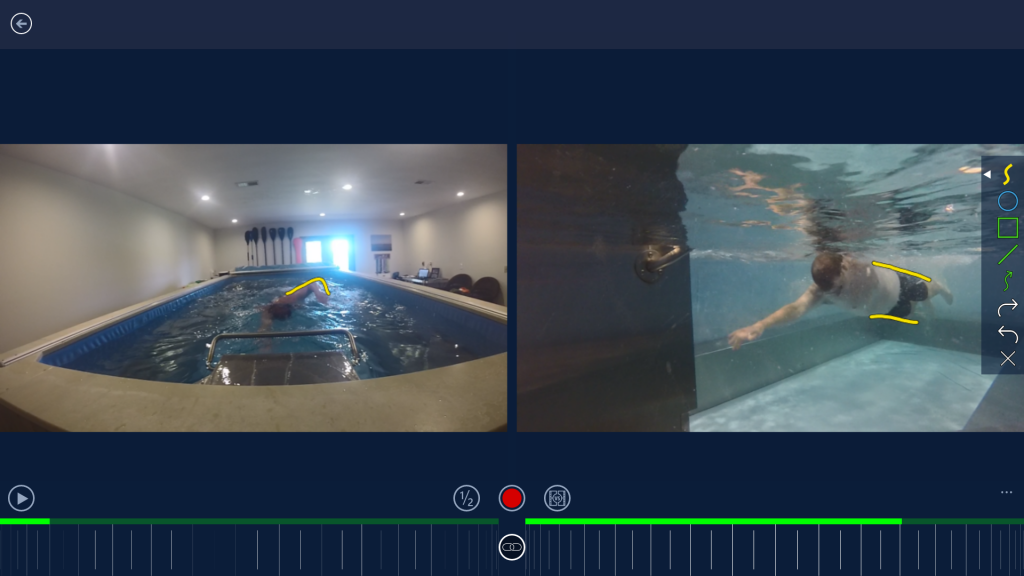
The impact of the left arm recovery movement on the body’s drag profile
The recovery phase (the time where the arm is in the air) had the potential to save Adam energy and to give him speed and ease. After we talked about optimizing the shape, direction and tempo of the recovery arm, his profile looked like this.
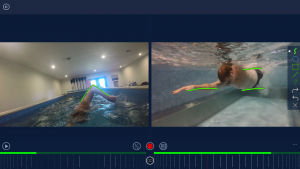
Corrected left arm recovery produces a hydrodynamic body profile
The recovery arm, being very heavy and unsupported by the water, has the potential to help or hinder the body. In the first image above, the left arm is flat, with the elbow dropped backwards and the hand inching forward. Sending the weight of the arm tilted back in this way can make the hips and legs sink. This is visible in the underwater view. The flattened out shape of the recovery arm also requires greater muscular energy to shift it forward, and also produces less of a mass change to aid in propulsion.
When we made the shift towards a wider swinging elbow that had height and mobility, there was instant speed. Greater mass change, increased hydrodynamic body profile underwater and less energy usage allowed Adam to swim with speed and ease. The changes are shown in the image above. He felt like he was ‘falling forward’. And when watching his video at the end of the lesson he said ‘is that really me?’! Looking stealthy, fast and effortless, way to go Adam!
Today I spent time in the open water with one of my favorite athletes. She started with hardly any swim experience, a fear of deep water, very little kinesthetic awareness and a huge desire to learn. Her persistence and dedication has her making progress in leaps and bounds, and excited to swim her first non wetsuit 70.3 in the fall.
In todays session we made several connections that were useful in increasing her awareness and swim skills.
During the warm up section of the swim, I asked her to connect mentally to a pool swim she had the day before. During that swim she had a breakthrough in her breathing control and swam several laps with ease. She described the ease of breathing being similar to a walking breath. It was important in the first stretch of her lake swim to recall this moment to strive for the same calm breathing and use this happy thought to achieve mental clarity. connect today with positive past experiences
In the next section of swimming I asked her to draw a little more attention to breathing. We aimed to connect the amount of air inhaled, to the amount of breath exhaled. Making this connection was aimed to increase the sustainability of breathing ease. connect inhalation with exhalation
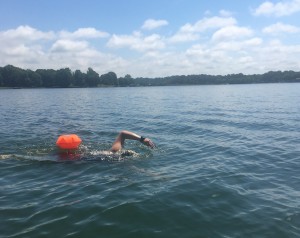
Lake Norman July 17 2016, Water 86F/Air 80F
Next we connected her hand entry to a tempo using the Finis tempo trainer metronome. Making this connection helps keep the body moving with fluidity and continuity. After several intervals, we combined the tempo and breathing awareness. connect tempo with fluidity in movement and breathing
The next connection was making the tempo faster, while holding onto stroke thoughts and length. Each tempo we repeated a minimum of three times. The aim of this exercise was to get the neuromuscular system used to firing a little more quickly to swim faster. Repeating the interval gives the brain and muscles time to accept and adapt to the task. connect tempo with speed
Once we had a found a faster tempo that was sustainable, we wanted to connect some improvement areas of the stroke to the new stroke rhythm. I asked her to synchronize the tempo to the core rotation, and then to the kick. The aim of this connection was to highlight areas of the stroke that needed attention to keep the faster tempo fluid and smooth. connect tempo with pockets of potential for ease and speed
Take some time in your next swim to make connections, and let us know how you get on,
Coach Dinah

 July 31, 2016 8:56 pm |