What is your data telling you?

These days athletes are the most excellent data collectors. It is so easy to connect movement to numbers with the available devices. These numbers may get looked at, analyzed, compared to and logged. In swim data, what can these numbers tell us? We have many to look at – distance, pace, stroke rate, stroke count and swolf – and they are easily collected. What can we learn from them?

Finding immediate room for improvement, highlighted via data, was the situation recently in the Discovery Aquatics studio.  The athlete came into the session frustrated by her stroke count slowly climbing over the last couple of weeks. She was tracking the data, and despite her best efforts could not manage the counts. It took less than 30 minutes to look at her swimming, find the areas where she could gain efficiency, drop the stroke count, and as a consequence pick up speed.

This process forms a wonderful feedback loop that we can view like this:
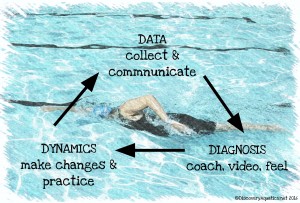
Find and Fix Feedback Loop

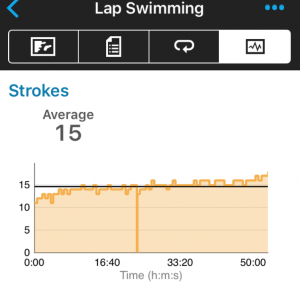
And to see the reality of this loop we begin at the top by looking at the data file:
IMG_9354

Stroke Count Data File

From the data file of this workout, the athlete could see the stroke count gradually climbing. This was the trend from the last couple of weeks training. It was frustrating when she could not identify the problem and improve the stroke count. She did the right thing and reached out for some time in the studio to help diagnose the issues. A coach can quickly pinpoint the areas for improvement to maximize efficiency and gain speed. Here is an image from the first video analysis. We can see how the body line angles are contributing to resistance and drag, and increasing stroke count.
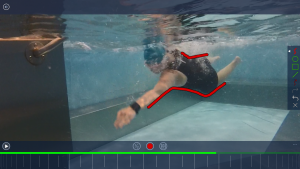
aleah2

Non Hydrodynamic Body Line

It is my goal as the coach to identify the main technique areas to address in order to improve the body position. Then how do I enable the athlete to see what is needed, implement and feel the change. We found 4 areas that needed fine tuning – using the core to drive the portion of the stroke from recovery entry to lead arm extension, dropping the head to align with the spine and be held in harmony with gravity and the water density, creating a consistent angle of rotation through the whole torso by engaging lower core muscles, and creating an early catch with the palm facing backwards. After some time working on the areas needed for improvement we reviewed video again. This step is important to allow the athlete to get visual confirmation from the change of movement and different feel in the stroke. This really helps ingrain the sensation and will make retrieval in her next pool session easier. Here is an image from the more efficient stroke, and we can see how the body line angles are far more hydrodynamic and will result in a reduction of stroke count.
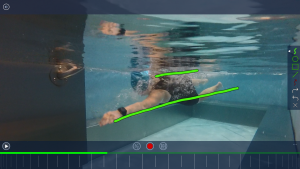
aleah1

Improved Hydrodynamic Body Line

As this athlete is in half ironman training, we took the improved stroke immediately into the lake to challenge the new movement patterns in the open water environment. The continuity of open water swimming allowed her to settle in and cycle through the changes, and visualize finding efficiency in a more race like setting.
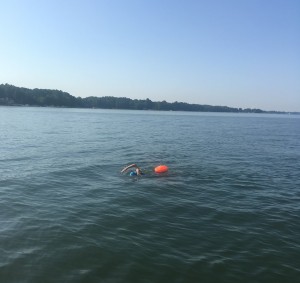
aleah3

New Movement Patterns in Open Water Environment

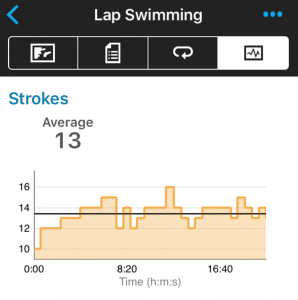
Now the athlete has the information to move forward with targeted practices using specific focal points. As she is doing this, the collection of more data is useful to confirm the connection between stroke efficiency and speed. This just in is a sample from her second swim after her session here at the studio.
IMG_9410

Stroke Count Data File

The feedback loop continues. Stroke count has decreased in the short term, can she keep using the feedback loop to make further improvements to stroke count and speed. Take the data to the next level, insert it into the feedback loop, look for areas to improve, make changes and practice, use data for confirmation. Be in control of your progress.

Coach Dinah


Q & A with Triathlon Coach Suzanne Atkinson

For the past 3 months Coach Suzanne from Steel City Endurance has been writing my tri plan. We have known each other for several years, taught and coached swimming together, traveled together and written a book together. I thought it would be interesting to see her responses to some questions I had, and get a little insight into a coaches mind. I think she had fun answering them too!

Before you became a triathlon coach, what quality or trait of yours did you anticipate being the most useful in coaching?

The ability to solve problems in order to prioritize and plan a course of action for an athlete.

Is that still your best quality or trait as a coach today?

My best quality now is the ability to solve these problems dynamically, sometimes on a day to day basis, with good communication, understanding their current level of fatigue and stress and how they are responding to the training activities they have been doing. So that all falls apart if myself or the athlete are not communicating well. I’d say then that communication may be my best strength and even then can always be improved.

What aspect of coaching do you enjoy the most?

I enjoy building the relationship and getting to know my athletes on a personal level beyond their athletic goals. For example getting the opportunity to meet their families and connecting on a deeper level than sports. After that I like seeing the improvements!

What range of athletic abilities have you coached?

I have coached everyone from those who have never swam or exercised before for fitness to advanced triathletes with ‘podium’ speed prior to me meeting them. The needs vary of course but what is common are the need for communication and them of course solving that puzzle of teaching or guiding them to the next step that will help them progress forward.

What is the one common quality of any level athlete that makes them easy to coach?

The ability to communicate honestly and be open for feedback. That is two but we will let it slide.

What is the most challenging quality?

Obviously things like not communicating or not doing workouts makes its challenging. But assuming they are doing that, I think strong preconceived ideas about what training should look like makes it challenging. There is a lot of good information available online and in magazines and blogs, but any individuals best course of training won’t conform to all of the things authors are writing about. One benefit of a coach is that the coach can help the athlete choose their path through that forest of information. So I guess an athlete that continuously wanders can be challenging to work with.

Can you mention the most important steps you take in planning a program for an athlete?

1. Gathering information about training background and prior race experience.

2. Understanding their personal goals and reasons for participating in their sport.

3. Gathering potential main races or events they want to prepare for.

4. Assessing strengths and weaknesses at present.

5. Planning an initial course of action based on their available time.

Then getting on with the plan and learning how they respond to it and enjoy it. The real work starts once this plan rolls into motion.

In general what workouts do triathletes skip the most?

Haha! The one they need the most! For one person it may be a day of swim technique and they just want to swim long (preconceived idea about what is best). For a different athlete it may be a long bike ride, and they will sub it with an extra run with friends. People tend to do more of what they like and if time is short and they can only do say 2 runs this week not 3, they tend to skip the one that is most unfamiliar or most challenging.

This goes back to the coaches job of guiding the athlete through the forest. I shouldn’t be giving athletes complex, difficult to understand workouts the week before their child’s wedding for example. So if I know there is a lack of time beforehand, I may only put one run on their calendar….the one they would be most likely to skip. If it is the only choice they will be more likely to do it. Then they can fill in with runs they like more.

What goes through your mind leading up to and on race day of an athlete?

Have I trained them well enough? Are they ready for race day? Oops I didn’t realize the run was 18 miles and not 13 miles. Closer to the race there will be more practicing of things like transition, what to do on travel day, reviewing emotional status of the athlete and helping them get centered and focused on the process of race day. Sometimes I stress that we did too much or not enough, but it always works out.

What do you consider success for your athletes?

Good question! I consider a success when the athlete achieves the goals they set out to with a caveat….Most goals are things like not finish last, finish top half of age group, be on the podium etc. These are dependent on outside things we can not control like who shows up on race day. So we need to reframe as process goals and compare apples to apples. Same course, faster time for example. Other athletes have less ordinal goals, not caring about placing or times, but they want to be more active or lose weight or get more comfortable on the bike. All those are successes when the athlete follows through.

What is the best feedback you have ever received regarding your coaching?

A mother of two teen triathletes said to me ‘You’re an incredible coach. I hope someone is telling you that every day’.

I always look for constructive ways to improve, but for me the drive to improve is built in. I’d seek out my flaws if no one was telling me. But getting positive feedback helps me keep moving forward knowing what I do is valued by my athletes.

What’s the most fun fact about you?

I carved a wooden duck my freshman year at college. It is about 2 inches long. I brought a block of wood and a knife to school with me and worked on it as a way to relax. My life long college pals still joke that maybe I would forget a birthday but I can carve a duck!

IMG_7593

Coach Suzanne and Coach Dinah teaching at the National Training Center, Clermont FL