Downhill: It’s a sensation, not a destination
Correctly distributed and balanced body weight in the horizontal plane and the rotational plane will give the mind a sensation of swimming downhill. This subtle and gentle alignment of body parts will feel like you are traveling forward and down, hence the term downhill.
It is not uncommon for swimmers who have seen the word ‘downhill’ in print, to push and force the upper body to a downhill destination. Not good. This uses a lot of muscular energy and can leave the body misaligned and unstable.
Instead we are aiming to find balance and control of body position primarily with the core to achieve the downhill sensation. This will enable a swimmer to be balanced, hydrodynamic and able to combine recovery arm weight shift, gravity and recruitment of core muscles to propel.
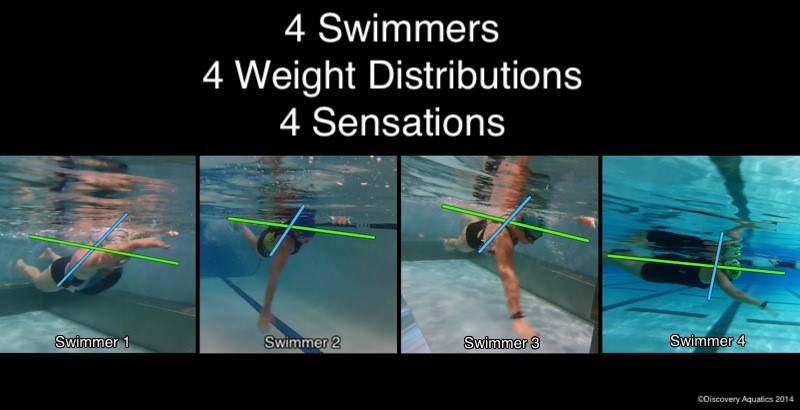
Lets take a look at the weight distribution of 4 Discovery Aquatics swimmers, and their comments about finding the downhill sensation.
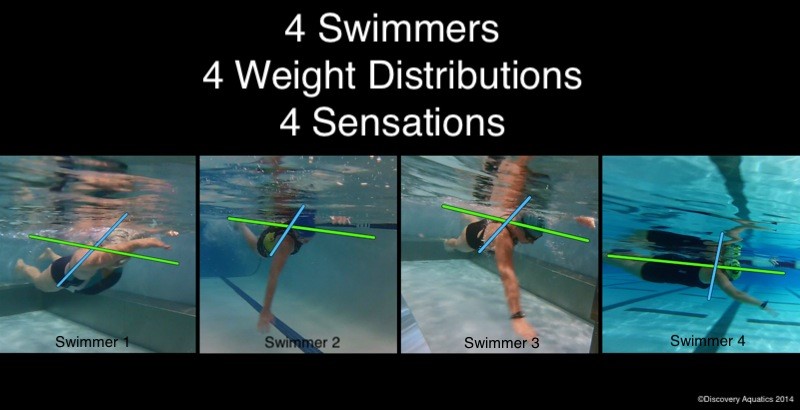
In the images above, we can see how each swimmer is placing weight differently about the horizontal plane (blue line) and the rotational plane (green line), and the impact this has on body alignment and potential for finding the downhill sensation. When these swimmers attend their lessons at the Discovery Aquatics studio we are assessing the improvements in balance and weight distribution and looking to see where changes need to be made to have them feeling the downhill sensation.
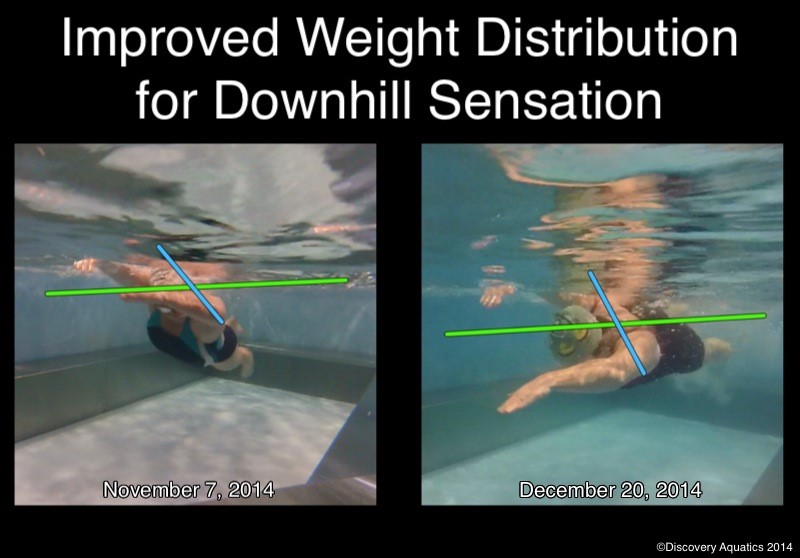
Swimmer 1 has arm weight forward but it is placed too high and too far to the left. This month she has been working on finding length and control through the core to allow the head to be aligned with the spine. She has also been working on keeping the arms forward and more in line with the shoulders. On feeling the downhill sensation she says ‘I do feel this on occasion. Not all the time. But, it’s a feeling that I like very much. I feel this when I have my legs extended, toes more pointed and back “long”…..I have to be the tallest me I can be with my head neutral and eyes looking straight down’. At her lesson yesterday we could see the progress:
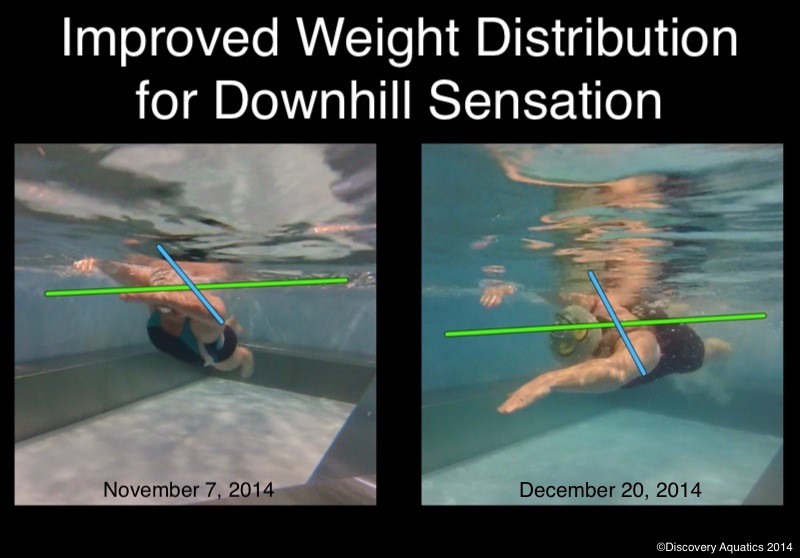
Swimmer 2 is placing too much weight back and down on the right. She has been working on finding core control in the upper torso to keep the lead arm forward, and lower torso to keep the legs aligned. On feeling the downhill sensation she says ‘I felt the sensation a few times and it felt like coasting down a hill. I’m a long way from mastering my stroke so I don’t get to enjoy the downhill sensation all the time. When I do it is very cool because I know I’m streamlined and I feel like I could swim all day’.
Swimmer 3 has too much tension and force on the downward position of the right arm and we see the consequence in the misaligned right leg. She has been working on removing tension and optimizing core control to gently and correctly position the arms and legs. On feeling the downhill sensation she says ‘I’ve not had that sensation and it sounds wonderful. I believe I’m still too rigid and tense’.
Swimmer 4 (I’ll own it, that’s me from last weekend) is balanced and most weight is distributed correctly. Increasing control of the right upper torso and shoulder will produce a better right arm shape and a slight weight shift forward. On feeling the downhill sensation I say ‘I strive to feel this with every stroke. It allows me to use the trio of fatigue resistant core muscles, weight shifts and gravity for effortless propulsion’.
Next time you swim, check if you are feeling the downhill sensation. If you can’t feel it, look for areas of tension and experiment with gentle and subtle changes in horizontal and rotational weight distribution.
Coach Dinah

 December 21, 2014 11:32 am