Collect and Connect
#s #s #s. Collecting swim data for your coach or your own analysis can be laborious. But what those numbers show makes the task totally worthwhile.
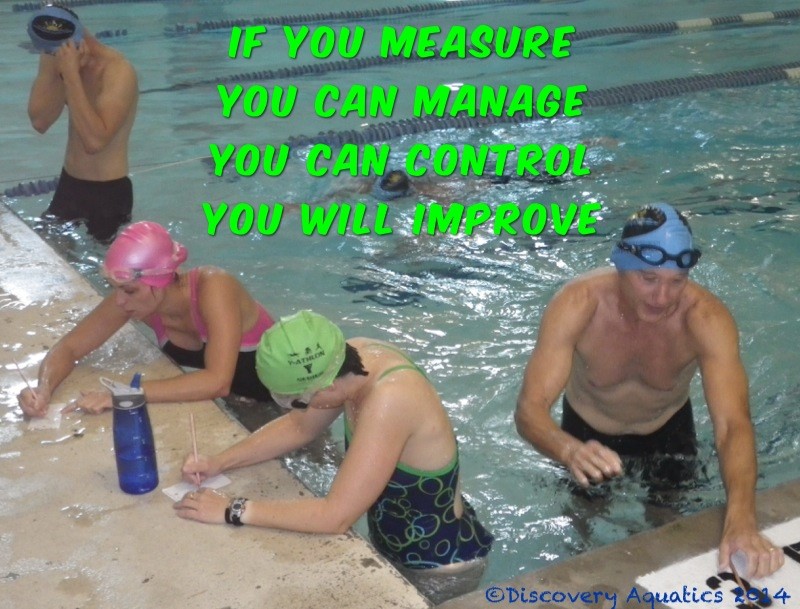
We are heading into the second month of a Technique Improvement Program at the Discovery Aquatics studio. Athletes have been completing assigned practices and collecting data where needed. Here are some examples of connecting meaning to the numbers.
Data for Direction
By looking at trends and patterns we are able to use data to determine where the next focus in training should be. In this case, the numbers show an athlete stuck in a one pace, one gear grind. From the first assessment metrics a set of 100 yard repeats were consistently at a 1:40 pace, and a stroke count of 16/25yd. A set of 50 yard repeats gave similar results in pace and stroke count. An experienced triathlete and swimmer of over 10 years, it is highly likely that he has ingrained this pacing over several thousand yards of repetition. So immediately we can guide the athlete in a more productive direction.
Bring on the Finis Tempo Trainer. Using an audible beep to guide swim tempo this swimmer was able to quickly retrain his neuromuscular system. From the first practice incorporating the Tempo Trainer at a slightly faster tempo than his norm and in combination with technique improvements, we could see him able to manage stroke counts and increase speed. Gold medal for him!
From the repeat assessment metrics a set of 100 yard repeats (not using Tempo Trainer) showed his ability to fasten tempos and manage stroke counts with a PR of 1:33 and a stroke count of 17/25yd.
He says ‘Really interesting. I found the consistency with the Tempo Trainer to be amazing.’
Data that Deviates
Trends and patterns also make it easy to catch the abnormal data points. During the first month this athlete made some excellent improvements in technique. This was reflected in a reduction of average stroke counts from 24/25yd to 20/25yd.
In a recent set of descending 100s this data was collected (time/sc/totals):
1:46 19/19/19/19—-76
1:41 18/18/20/20—76
1:38 20/20/20/20—80
1:35 18/20/20/21—79
1:33 18/21/22/23—84
I was curious if she felt any change in the last 50 of the final 100 where the SC had increased a little. Here is what she said ‘Yes I remember the last length of that hundred. I was pushing really hard and I was tired, it was certainly a struggle. I remember that my breathing was really off. I was trying to breathe every four strokes. I could feel lack of oxygen. That was the only 100 that the last 25 is what I would call uncontrolled.’
The sensation of pushing outside your limits is worth remembering. In a race situation it is often tempting to swim at an uncontrollable pace – at the beginning, chasing someone, towards the end. Here we have the data and connection to a sensation to support that the 2 seconds speed gain is not worth the effort put forth. Consistency in pacing as distance increases is a goal for month 2 of the program. I am looking forward to continued improvements.
Data for Development
Inconsistency in trends and patterns will also raise some questions. The data from the initial assessment for this swimmer looks great if we took isolated 100 yard times. A pace that varied from 1:24 to 1:37/100yd, stroke counts varying between 19-23/25yd and calculated tempos between 0.87 and 0.95sec/stroke raised some questions. What will happen to this data as distance increases? Why is there such a range?
A few weeks later a metric set showed 100 yard times at 1:29 and 200 yard times of 3:20. Calculated tempos of 0.87 to 1.00 sec/stroke, highlighting the difficulty in sustaining this tempo and pace over a distance that doubled in length. The approach was to slow tempo to increase sustainability during the next few practices. The data from this was interesting. As he tried to slow down tempo, stroke count increased. This revealed inadequacies in stroke fundamentals and highlighted the connection between data and the developmental stage of his swimming. The focus for the coming month is clear.
He says ‘I was struggling to keep everything together at the same time. It turns into pure survival.’
I am looking forward to the data collection and connections from this month.
Coach Dinah

 December 11, 2014 9:22 am |