January Swimmer Spotlight
Introducing Natalie! A new swimmer to Discovery Aquatics, I was immediately impressed with her awareness and her ability to apply new concepts easily. Natalie comes from an impressive cycling background where fitness can trump technique to get results. She easily switched gears into swim mode where she now prioritizes technique over heart beats. I am looking forward to seeing her progress and be successful in her tri season where the skillful athletes switch gears effortlessly from the water to land.
How old are you? Early 50s (just turn 51)
Where did you grow up and what was your exposure to water and swimming? Grew up in small town in Georgia. The hot muggy summer days were spent at the local swimming pool with my best friends, Ann and Simone. My sister Simone and I never participated in any water sports but Ann was from Ohio and participated on a swim team. She could do a flip turn. As the resident expert among our small group, Ann was the official coach and captain. Splashing around and getting water up my nose attempting to do flip turns was my only exposure to any kind of formal swim training until Fall of 2008. My husband completed his first triathlon and I decided maybe I would like to give triathlons a try. I knew I needed help with swimming my first time and first lap in the lap pool. My friend suggested looking at YouTube. From 2008 to 2015, my knowledge of swimming technique came from internet searches and suggestions from folks at the pool.
Why did you come to Discovery Aquatics and what have you learned about yourself and your swimming? I stumbled upon Total Immersion Videos on YouTube. The swimmers from the mini advertising TI clips were efficient and graceful and I wanted to swim like those swimmers. Soon after viewing the video, I saw this woman swimming just like the swimmer in the video and I had to talk with her…Dinah of Discovery Aquatics.
What is your athletic background? Are there any similarities or contrasts between your other athletic experiences and swimming? Basketball was my sport from age 5 through high school until I had a knee injury which required major reconstructive surgery. As a part of the rehab, I was asked to ride a stationary bike which turn into riding a bike outside all the time. I began racing bicycles my senior year in high school (1982). I was a competitive cyclist until 2000. Qualified and competed in the 1988, 1992, 1996 and 2000 US Olympic Trials in road racing and track racing.
Swimming is the most technical sport I have ever attempted. You can be fit and have bad technique and you can still be a successful basketball player, runner or cyclist, but a fit swimmer does not translate into a fast swimmer.
How has your approach to swimming and practices changed since coming to Discovery Aquatics?
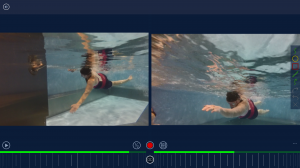
So far, I have only had one lesson with Dinah but that lesson was individualized and right on the mark for I needed. In another words, she is incredibly talented at assessing where you are and where you need to go but she also has the ability to communicate to each individual in a manner in which they can understand and be able to do what has been communicated. After the lesson, I worked on my Balance, Recovery, Timing of Rotation, Hydrodynamics, Catch, and Kick. I know that seems like a lot but I was given drills that I could easily focus on each part. I cannot wait for my next lesson so I can get a critique of what I have been working on so far and where to focus next. Without anymore fitness, one session with Dinah improved my 100 yard time by 15sec with the same amount of effort. I have also decreased my lap stroke count by 3 strokes with so much less energy expended. My goal this year is to compete rather than just participate in triathlon. Becoming a faster and more efficient swimmer is one step towards that goal.
Thanks Natalie, I am looking forward to a great year!
Coach Dinah

 January 27, 2016 1:25 pm |