Finding Air Part 1

The breathing moment in freestyle is challenging, no doubt about it. The head must move across the path of which the body is traveling to find a tiny pocket of air in which you have a very brief moment to inhale. In order to make this moment as seamless as possible the body needs to retain alignment and balance like a non breathing stroke. Fail to do this and you will decelerate.

The most common breathing patterns are to roll to the air every second, third or fourth stroke. This is 50%, 33%, or 25% of the strokes taken. It is well worth the practice to refine the breathing moment and reduce the risk of decelerating 50%, 33%, or 25% of the time.

Ultimately we are looking to maintain speed and momentum during a breath.

During a lesson last week at the Discovery Aquatics studio, we examined one particular area of the stroke that was impacting the swimmers ability to maintain momentum during the breath. We looked specifically at where she was placing the weight of the recovery arm during the breath. The image below was from her first section of swimming. The recovery arm is pulled up and back across towards the spine.
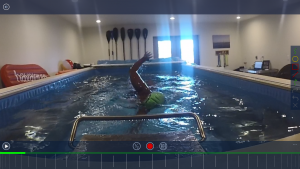
nbreathingbefore


The weight of the arm in this position causes the body to submerge, making access to air more difficult. The head must roll further around to find the air, or be pushed upwards to find the air….or both.


During the lesson we worked towards the optimal positioning of the recovery arm to give the body stability. This will enable a swimmer to find the air with greater ease and maintain forward momentum. The image below shows a more stable recovery position.
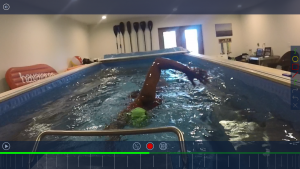
nbreathingarm


The weight of the arm in this position will help keep the body in a hydrodynamic position, making access to the air easier. The head can roll just enough to find the pocket of air and stay aligned with the spine. It is far less likely that the body will decelerate now.


If we look at before and after images from the side, we can see how the head and body are aligned with the change in recovery arm position.
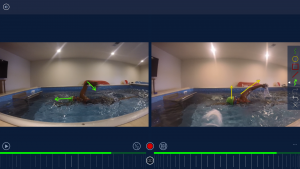
NbreathingsideThe swimmer could really feel a difference in her breathing moment on the left. She was able to detect her momentum continuing, and she was able to access the air with ease. As she continued to swim, some breathing moments were better than others. This is totally normal, but her increased awareness and feel, allowed her to detect the less integrated breaths, and make adjustments to the next breathing cycle.


Coach Dinah

March Swimmer Spotlight

Always a great time during lessons with swimmers Val and Jen who travel from Raleigh to learn a faster more efficient way to swim and they have a lot of fun in the process. After each session here at the Discovery Aquatics studio they practice together, and are able to enhance the learning process by giving each other instant feedback and sharing their experiences.. Lets get to know them.

How old are you?

Val: I turned 53 yesterday while we were swimming!
Jen: I am 44.

When did you begin your TI instruction and what have been your biggest takeaways in this time?

Val: I have looked at TI videos on line now and again for a couple of years, so was aware of Total Immersion.  But this winter Jen asked me to go to a TI workshop with her and that is when this new phase of my swimming began with Dinah and TI. My biggest takeaways from these past few months are: Organization – getting body to move as a unit. This included getting the timing of the 2-beat kick. And working ‘with’ the water – maintaining streamline. This included relaxing my arms.

Jen: I started my TI journey December 2015. My takeaways from this experience thus far have solidified my devotion to TI. I have learned to work WITH the water, relax into it and allow more ease. It had felt so counterintuitive for me to put forth less effort and still gain more propulsion, stability and balance. It also seems that my movement both in and out of the water mirror each other. If I am rushing, my muscles become tense and I can lose clarity in my thinking. However, slowing down my body and mind by highlighting focal points in my practice can smooth things out mentally and physically. Less overall stress!

What are your swimming race goals for this year?

Val: I plan to swim in several open water swims. These are fun for me. I don’t have time goals for these because conditions are so variable. But I do have a distance goal of entering the ‘big deuce’ which is a 2-mile swim.  In the pool, I am hoping to get my 1000 time to 17:30 (and then maybe even lower than that).  I can now maintain my 100 times in 1:40 and am working on getting that down to 1:35. I am also excited to begin working with the ‘math’ of my swimming and to understand my DPS and tempo relationships.

Jen: This year, I am training for the Alcatraz swim. The TI concepts have helped me be more deliberate and thoughtful in my movements which will cut down on wasting energy, allowing me to finish feeling strong and exhilarated.

How has your thinking changed to gain speed in your swimming?

Val: Now I think about speed as coming from a gentle momentum through the water. So when I am reaching for speed now I focus on my streamline position rather than on doing something ‘harder’.

Jen: I focus on relaxing into the water and cycling through the focal points I have learned, making streamline a priority. I am also working with the thought ‘the faster I go, the more ease I want to feel in my stroke’.

How do you manage practicing together and taking TI concepts into your group swim workouts that are not TI based?

Val: Luckily for me, I have my swim buddy Jen and we swim together 2 to 3 times per week. I swim on my own another 1-2 times per week. I have not returned to my group swims because I felt I needed to better understand my swimming first, I needed time.  It has been 4 months now and I am just now ready to return to a group situation – I will adapt drills to my TI focal points as needed.  So, for instance, if we do a “zipper drill” I will instead think about the painting a line on the tracks to ingrain correct recovery position.

Jen: I am lucky to have my friend Valerie to swim with 2-3x/week. It’s so great to have a swim buddy going through the same TI practices so that we can share things that we discover; different nuances and ways of approaching/understanding focal points. Valerie also has a video camera that we can use to check that we are on the right track. In the group I modify any drills they may be doing by replacing them with TI focal points.

Here is a look at how they have improved over the last 3 months. I am looking forward to greater speed gains and translating the improvements into open water swimming.

Coach Dinah