The Mind’s Eye – what is in your swim scene?
The Mind’s eye. What does that mean to you? By definition it is the ability of the human brain to visualize; to conceive images or recollect scenes. These mental images are formed by accessing our memory, or created by modifying stored perceptions. It is an incredible function of the human mind, and a completely private event. Our scenes are not tangible nor available for anyone else to see.
Mental imagery has a role in many aspects of life – holding memories, planning, goals, dreams, decision making and motivation. In sports and swimming we can use mental imagery to develop skills, build on strengths and find weaknesses and of course to compete effectively.
Each persons ability to create mental imagery or visualize is unique. Not really a surprise as we all see real objects differently, and we all have our own bank of memories and perceptions. And for a small percent of the population they are unable to ‘see’ anything. In a recent chat amongst Fresh Freestyle co-authors, I asked them to share what they ‘see’ when they swim. Coach Celeste ‘sees’ in movies. When she is swimming, her visualization is displayed as a movie of herself in that swimming moment. Coach Suzanne prefers to ‘see’ visuals as either stills, or in motion, of others swimming with correct form for her to emulate. How about you? What do you ‘see’?
I usually begin a swim with a real time visual of what my mind sees me doing, then change to isolated stills when I am correcting form or feeling movements. These stills are sometimes of myself or swim figurines. I asked Coach Celeste to sketch an image of an example image I might see.
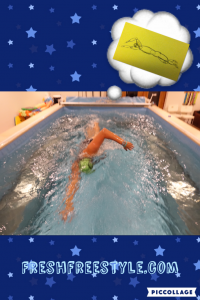
In this particular practice I began ‘seeing’ with a real time movie of myself swimming. As I ‘viewed’ this film and connected it to how I was feeling, the area of my stroke that needed attention became apparent. From here, I began to break it down into ‘seeing’ stills of swim figurines. The first one looked a little like this:
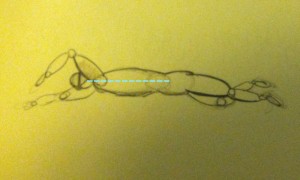
Find a long stable line through the spine
As I swam, I kept the image of the line running along my spine. I felt tall and stable. Then I added a focus. I wanted to find the low side edge of the body, and keep that line long and stable through the torso as I extended forward. My swim scene looked a little like this:
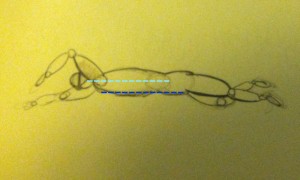
The right low side edge of the body is long to match the length of the spine
I was ‘seeing’ the length of the low side edge of the torso with each stroke. I was also feeling this low edge sit just beneath the line of the spine. Holding the length of the edge just a couple of inches below the spine. After some time swimming I added to the swim scene. I added the length and position of the high side edge of the torso. My visual looked a little like this:
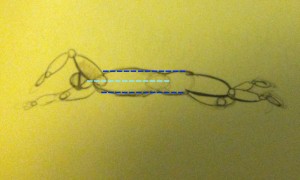
The left high side edge of the torso is long and sits just higher than the spine
I felt stable and aligned through the torso. The angle of rotation was controlled by these long lines at around 30 degrees. Not a lot of rotation, just enough to remain balanced, streamlined and able to uncoil this angle to aid with propulsion. This brought me to the final scene. I visualized using just the right amount of core (oblique) activation to help rotate the core to switch from one long, stable hydrodynamic platform to the next. Ending each rotation by finding the lengths of previous swim scenes. The mental image looked a little like this:
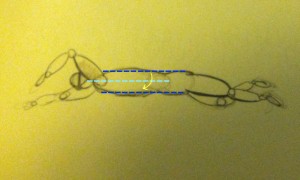
Control the rotation from one long, stable, angled platform to the next
I felt connected and synchronized with the swim movements. My mental image then changed backed to a real time visual of myself swimming to reinforce the stability I had found.
Using mental imagery happens during most swims I do. Next time you are swimming, be aware of what you ‘see’, and ask yourself if you are able to find a useful swim scene. How is the quality of your picture? If you would like to improve your ability to visualize, go ahead and try these exercises. First on land:
- Find a still image of someone swimming that you would like to swim like. Look at every detail on the image. Now close your eyes and try to recreate the picture. Try and find every detail in your mind. Open your eyes to get more details if you need to, then close your eyes and find them in your mental image. Repeat as often as you can. When you feel yourself get good at the recall, move to another image or go on with the next exercise. You may even use the first image from this post if you like.
- Find a video of someone swimming efficiently. After watching, close your eyes and try to recall the image of the moving swimmer. Go into as much detail as you can about the swimmer and they way they move. Are you able to see this athlete in 3 dimensions? Practice often, and view the mental scene from many angles. Here is a great video to watch.
- Move on to this exercise when you feel ready. Find one of your favorite videos from exercise 2. Now in your mental scene, replace the swimmer with yourself. After you feel good placing yourself in the scene, connect to the imagery with your senses. How does the swimming feel on your body and muscles? What is the water temperature? How does the water feel on your face and body? What can you hear? Smell? Add one challenge at a time to enhance your ability to visualize effectively. For an added challenge, repeat this exercise with your eyes open. Can you do it?
After you have been strengthening your ability to create mental imagery on land, now take it to your swimming. Repeat the steps above progressively with your swim practices. What have you learned about yourself and your swimming?
Coach Dinah

 December 12, 2016 8:00 am |