Downhill: It’s a sensation, not a destination

Correctly distributed and balanced body weight in the horizontal plane and the rotational plane will give the mind a sensation of swimming downhill. This subtle and gentle alignment of body parts will feel like you are traveling forward and down, hence the term downhill.

It is not uncommon for swimmers who have seen the word ‘downhill’ in print, to push and force the upper body to a downhill destination. Not good.  This uses a lot of muscular energy and can leave the body misaligned and unstable.

Instead we are aiming to find balance and control of body position primarily with the core to achieve the downhill sensation.  This will enable a swimmer to be balanced, hydrodynamic and able to combine recovery arm weight shift, gravity and recruitment of core muscles to propel.

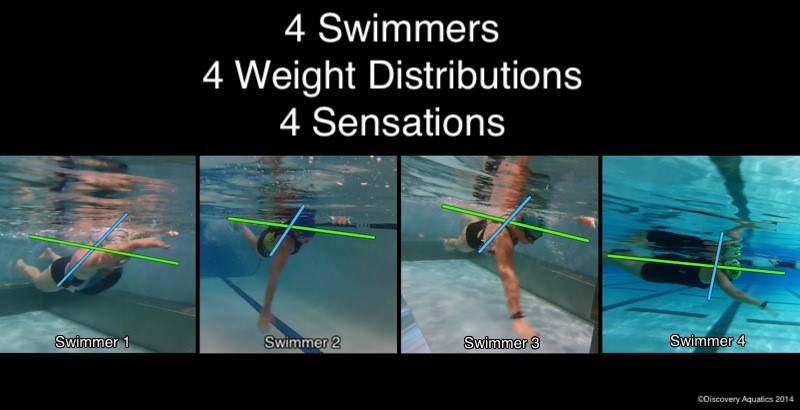
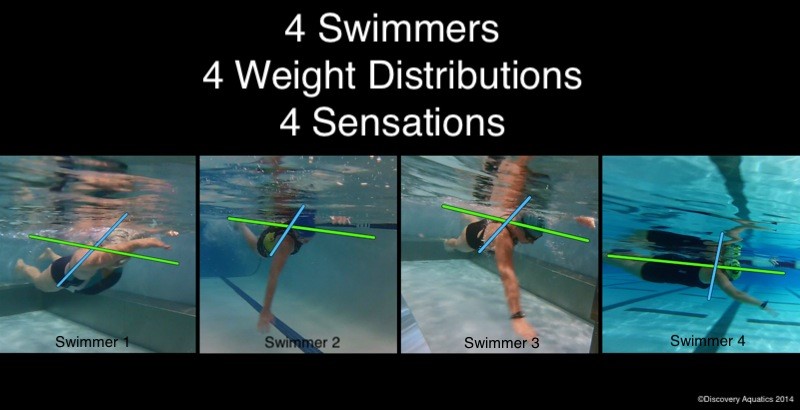
Lets take a look at the weight distribution of 4 Discovery Aquatics swimmers, and their comments about finding the downhill sensation.
downhill


In the images above, we can see how each swimmer is placing weight differently about the horizontal plane (blue line) and the rotational plane (green line), and the impact this has on body alignment and potential for finding the downhill sensation.  When these swimmers attend their lessons at the Discovery Aquatics studio we are assessing the improvements in balance and weight distribution and  looking to see where changes need to be made to have them feeling the downhill sensation.

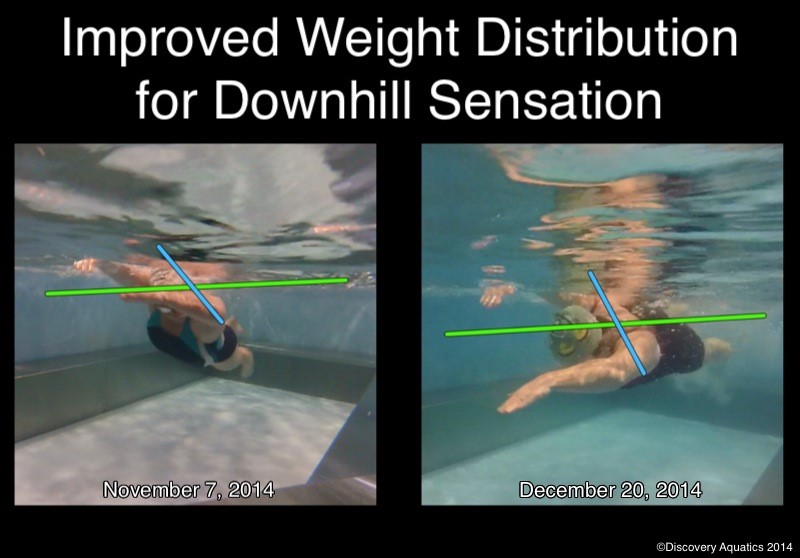
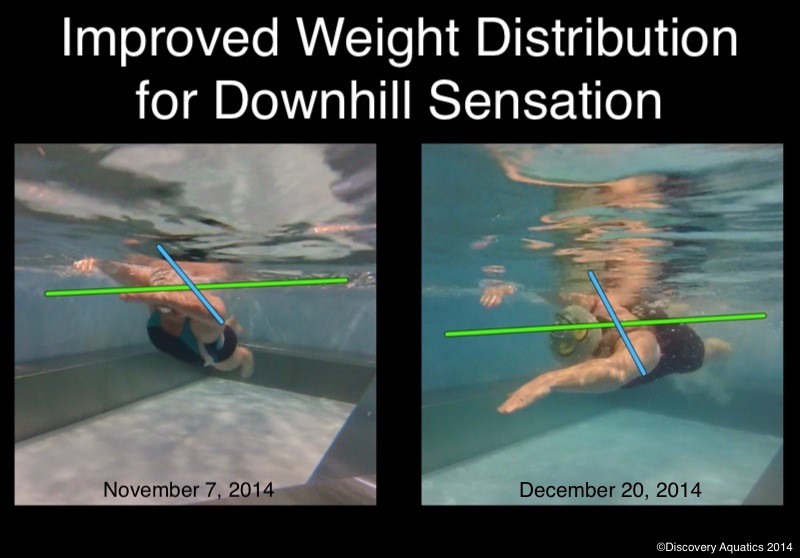
Swimmer 1 has arm weight forward but it is placed too high and too far to the left. This month she has been working on finding length and control through the core to allow the head to be aligned with the spine. She has also been working on keeping the arms forward and more in line with the shoulders. On feeling the downhill sensation she says ‘I do feel this on occasion.  Not all the time.  But, it’s a feeling that I like very much.   I feel this when I have my legs extended, toes more pointed and back “long”…..I have to be the tallest me I can be with my head neutral and eyes looking straight down’.  At her lesson yesterday we could see the progress:
donna


Swimmer 2 is placing too much weight back and down on the right. She has been working on finding core control in the upper torso to keep the lead arm forward, and lower torso to keep the legs aligned. On feeling the downhill sensation she says ‘I felt the sensation a few times and it felt like coasting down a hill. I’m a long way from mastering my stroke so I don’t get to enjoy the downhill sensation all the time. When I do it is very cool because I know I’m streamlined and I feel like I could swim all day’.

Swimmer 3 has too much tension and force on the downward position of the right arm and we see the consequence in the misaligned right leg. She has been working on removing tension and optimizing core control to gently and correctly position the arms and legs. On feeling the downhill sensation she says ‘I’ve not had that sensation and it sounds wonderful. I believe I’m still too rigid and tense’.

Swimmer 4 (I’ll own it, that’s me from last weekend) is balanced and most weight is distributed correctly. Increasing control of the right upper torso and shoulder will produce a better right arm shape and a slight weight shift forward. On feeling the downhill sensation I say ‘I strive to feel this with every stroke. It allows me to use the trio of fatigue resistant core muscles, weight shifts and gravity for effortless propulsion’.

Next time you swim, check if you are feeling the downhill sensation. If you can’t feel it, look for areas of tension and experiment with gentle and subtle changes in horizontal and rotational weight distribution.

Coach Dinah


Collect and Connect

#s #s #s. Collecting swim data for your coach or your own analysis can be laborious. But what those numbers show makes the task totally worthwhile.

metrics


We are heading into the second month of a Technique Improvement Program at the Discovery Aquatics studio. Athletes have been completing assigned practices and collecting data where needed. Here are some examples of connecting meaning to the numbers.

Data for Direction

By looking at trends and patterns we are able to use data to determine where the next focus in training should be. In this case, the numbers show an athlete stuck in a one pace, one gear grind. From the first assessment metrics a set of 100 yard repeats were consistently at a 1:40 pace, and a stroke count of 16/25yd. A set of 50 yard repeats gave similar results in pace and stroke count. An experienced triathlete and swimmer of over 10 years, it is highly likely that he has ingrained this pacing over several thousand yards of repetition. So immediately we can guide the athlete in a more productive direction.

Bring on the Finis Tempo Trainer. Using an audible beep to guide swim tempo this swimmer was able to quickly retrain his neuromuscular system. From the first practice incorporating the Tempo Trainer at a slightly faster tempo than his norm and in combination with technique improvements, we could see him able to manage stroke counts and increase speed. Gold medal for him!

From the repeat assessment metrics a set of 100 yard repeats (not using Tempo Trainer) showed his ability to fasten tempos and manage stroke counts with a PR of 1:33 and a stroke count of 17/25yd.

He says ‘Really interesting. I found the consistency with the Tempo Trainer to be amazing.’

Data that Deviates

Trends and patterns also make it easy to catch the abnormal data points. During the first month this athlete made some excellent improvements in technique. This was reflected in a reduction of average stroke counts from 24/25yd to 20/25yd.

In a recent set of descending 100s this data was collected (time/sc/totals):

1:46 19/19/19/19—-76

1:41  18/18/20/20—76

1:38   20/20/20/20—80

1:35   18/20/20/21—79

1:33   18/21/22/23—84

I was curious if she felt any change in the last 50 of the final 100 where the SC had increased a little. Here is what she said ‘Yes I remember the last length of that hundred. I was pushing really hard and I was tired, it was certainly a struggle. I remember that my breathing was really off. I was trying to breathe every four strokes.  I could feel lack of oxygen. That was the only 100 that the last 25 is what I would call uncontrolled.’

The sensation of pushing outside your limits is worth remembering. In a race situation it is often tempting to swim at an uncontrollable pace – at the beginning, chasing someone, towards the end. Here we have the data and connection to a sensation to support that the 2 seconds speed gain is not worth the effort put forth. Consistency in pacing as distance increases is a goal for month 2 of the program. I am looking forward to continued improvements.

Data for Development

Inconsistency in trends and patterns will also raise some questions. The data from the initial assessment for this swimmer looks great if we took isolated 100 yard times.  A pace that varied from 1:24 to 1:37/100yd, stroke counts varying between 19-23/25yd and calculated tempos between 0.87 and 0.95sec/stroke raised some questions. What will happen to this data as distance increases? Why is there such a range?

A few weeks later a metric set showed 100 yard times at 1:29 and 200 yard times of 3:20. Calculated tempos of 0.87 to 1.00 sec/stroke, highlighting the difficulty in sustaining this tempo and pace over a distance that doubled in length.  The approach was to slow tempo to increase sustainability during the next few practices. The data from this was interesting. As he tried to slow down tempo, stroke count increased. This revealed inadequacies in stroke fundamentals and highlighted the connection between data and the developmental stage of his swimming. The focus for the coming month is clear.

He says ‘I was struggling to keep everything together at the same time. It turns into pure survival.’

I am looking forward to the data collection and connections from this month.

Coach Dinah