Do you wig out in the warm up?

A recent discussion with a Discovery Aquatics athlete led to this post. The discussion goal was to pinpoint the cause of nervousness or anxiety getting into the pool and during the first few minutes of swimming. She describes the feeling as ‘impending doom’ lurking over her as she gets in the water and begins swimming.

Once we had talked about what was happening physiologically during this time, we were able to connect her emotional response to the sensations and then develop some strategies to make the transition from deck doom to swimming success. Here is a summary of our discussion.
Houck_Medford_TI_2016_NTC-30

Humans are a finely tuned and balanced organization of complex systems. Broadly speaking and in relevance to this discussion, the brain and nervous system, cardiovascular system, respiratory system, endocrine system, musculoskeletal system and energy systems are all working together to maintain harmony. This harmony is particularly disrupted when you begin exercise, going from inactivity to activity, creating demands on the body and on the organization of these systems. These complex systems function to meet the demands of the increased workload of exercise which, broadly speaking, is the delivery of nutrients and oxygen, and the removal of waste and heat.

One waste product, carbon dioxide (CO2),  can create some unpleasant sensations during the first minutes of exercise.  During this time, a huge increase in demands on the body is occurring and matched by an increase in CO2 production.  CO2 is harmful to the human body and the body works hard to transport it to the lungs where it is exhaled and exchanged for oxygen.

It is fascinating to look at how the body knows CO2 is on the rise. When CO2 rises, the pH of the blood changes. It becomes more acidic. There are special receptors located in the brain and heart that are sensitive to pH. When these receptors sense a deviation from normal balance and harmonious conditions, the lungs are stimulated to increase breathing rate and volume, with the end goal to remove the CO2.

This is a wonderful system. On land. Where you can easily allow the increased rate and depth of breathing to occur.

How about when you are swimming freestyle? The moment to inhale oxygen is brief and delicately timed.  Finding a harmonious exchange of CO2 for O2 can be challenging for many, even once the body has adjusted to the increased workload. The first few minutes create extra challenges with the steep rise of CO2 and lack of freedom to breathe in when you would like.

This sensation of not being able to regulate the amounts of CO2 and O2 can lead to panic, fear, anxiety and in this case ‘impending doom’.

Here are some strategies we discussed to help the body adjust to the initial CO2 rise that occurs during the first few minutes of swimming:

  • warm up on land to get the gas exchange happening in an environment where you can breathe in and out as you like – light jog, elliptical, dynamic stretching, stationary bike
  • make your warm up swim pace easy and comfortable, ease into your practice
  • keep exhalation soft and gentle through mouth and nose, sense if you are holding breath, release it
  • breathe more often during the warm up – perhaps every 2nd stroke to your favorite side
  • use a swim snorkel during warm up until you are confident to try without
  • learn about your reaction to unpleasant sensations, acknowledge and accept, try not to react

Giving this athlete the understanding of what is happening during her warm up has been a wonderful light bulb moment for her:

‘You said something in Tuesday’s swim instruction that helped me out a bunch: “feel the co2 build up as you begin moving, accept it, release it gently”.    This has been something I fight during the first 100 and I didn’t know what it was before.  It’s like a feeling of impending doom for me.  And, after about 100 or 150 it goes away.  Thank you!  Now I know what I’ve been feeling!’

Coach Dinah


Overcome Open Water Anxiety with SwimEQ

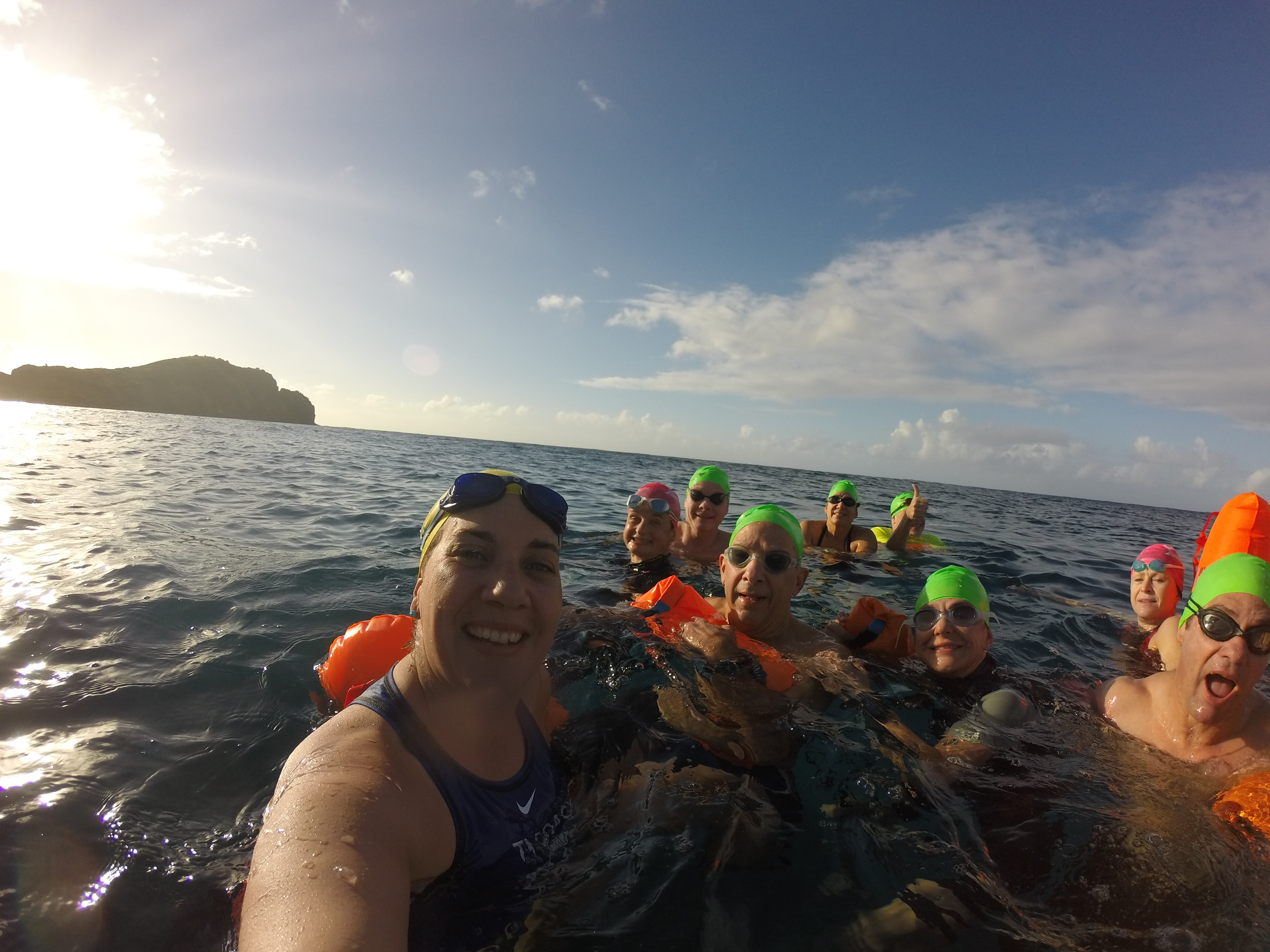
This week I am fortunate enough to be in St John USVI teaching at a week long open water swimming camp.

DCIM100GOPRO


Myself and 3 other Total Immersion Master Coaches, along with Terry Laughlin are leading a group of 17 campers and 7 apprentice coaches through the Total Immersion methodology, and applying it to open water swimming with remarkable results. We swim in the Caribbean Sea in sporty deep water surf conditions, an excellent environment to test the ability to remain focused on efficient swimming technique.

But there is another dimension…..What is the strategy if a swimmer or coach experiences any type of anxiety or fear or stress?

No problem, this is where the Discovery Aquatics SwimEQ program comes into play. I presented the SwimEQ program in two parts within the first 24 hours of camp.

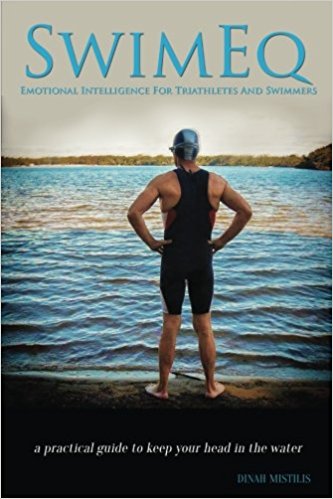
What is SwimEQ? EQ is an abbreviation for Emotional Intelligence. It is the ability to recognize and manage emotional fluctuations in your body. High EQ is a valuable skill to optimize learning and performance. SwimEQ is a purpose designed Emotional Intelligence program for swimming activities – learning in any water environment, swimming in open water and swimming in race situations.

Several Campers have shared their experiences of anxiety during the camp. Here are some examples of triggers that produced emotional fluctuations. SwimEQ gave each person the skills to assess their anxiety and employ techniques to overcome anxiety to then enable them to return focus to their swimming technique.

  • The entry from Salt Pond Bay Beach into the water is clear and calm with soft white sand. Once you head out about 25 yards the water deepens and it is not possible to stand. Seeing the white sand become further and further away was an anxiety trigger for some swimmers.
  • One of the big differences between pool swimming and open water swimming is not having the pool wall at the end of a length to break and breathe. Swimming continuously in open water and feeling like you are not getting enough air was an anxiety trigger for some swimmers.
  • Along similar lines the boundaries of the pool make it easy for your brain to compartmentalize distances. In the open water it is difficult to judge a distance to a target, often times your destination seems so far away. Questioning if you are capable of completing a distance was an anxiety trigger for some swimmers.
  • We swim with personal buoys for 3 reasons – it makes us more visible to boaters, we can carry our belongings in the dry bag, and we can use the float for support when resting. The buoy buckles around your waist. Having the buoy unclip and drift off in the middle of a long swim was an anxiety trigger for one swimmer.
  • Once we swim out of the calm waters of the bay, the surf gets choppy and challenging. The rise and fall of the large waves can induce sea sickness. The movement of the waves inducing nausea and dizziness was an anxiety trigger for some swimmers.
  • The waters of the Caribbean Sea where we have been swimming are salty. Having the salty water in your mouth and nose can cause discomfort. Getting the salty water in your eyes stings. Having goggles snap at the nose bridge and an influx of salty water into the eyes was an anxiety trigger for one swimmer.


And my own personal moment of anxiety:


DCIM100GOPRO


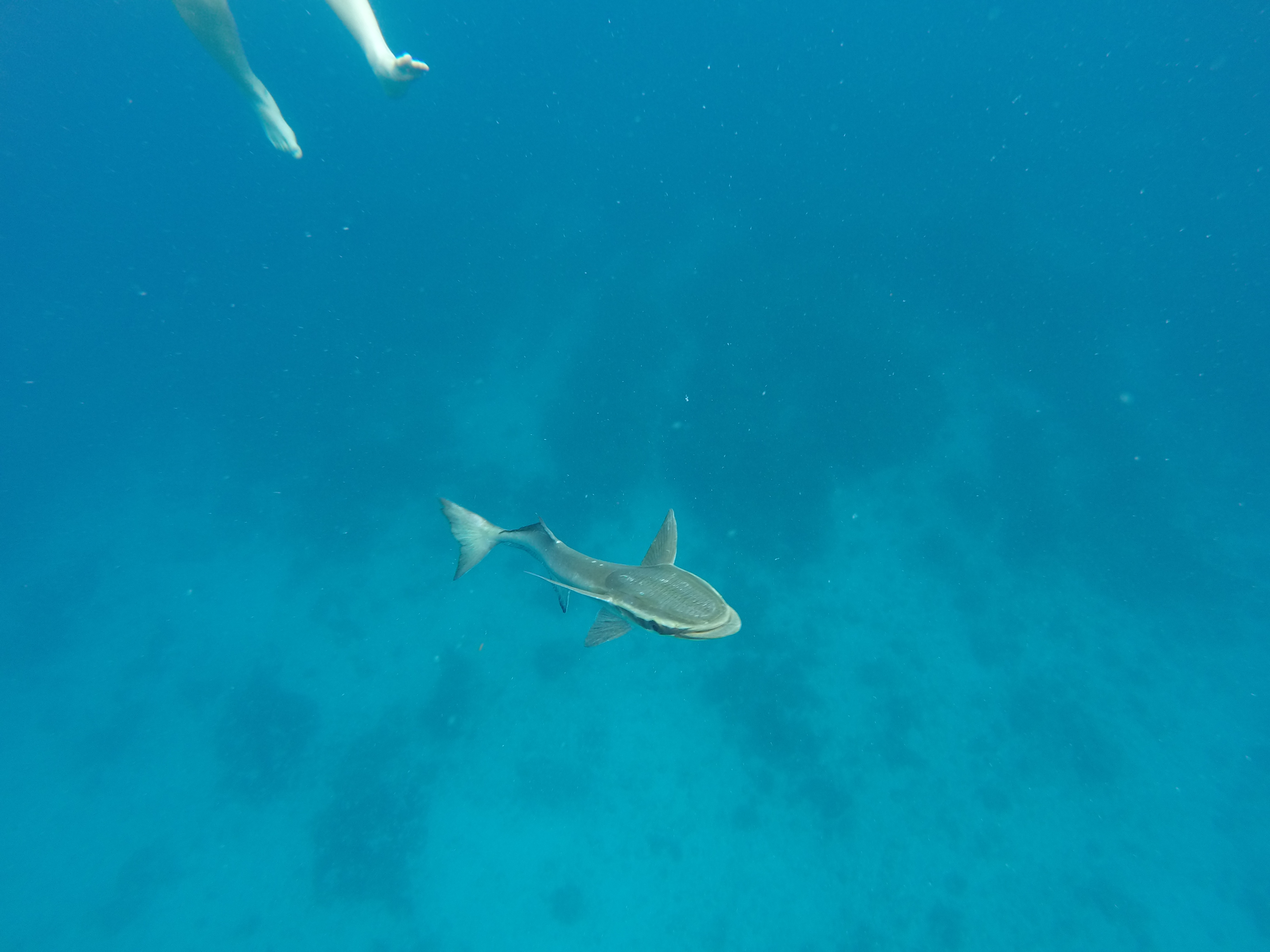
On the first day of camp we went for a 2 mile swim. We had stopped to regroup and this fish (he looked like a mini shark to me) came into the middle of the pod, exploring each person closely. I had an initial anxiety moment, but after I applied SwimEQ techniques I was calm and enjoyed watching his curiosity, his graceful movements and taking some pictures. Turns out he is a remora fish, the suckerfish that attaches to sharks.

The progress we see towards efficient swimming from every camper in each session is remarkable. This is only possible if each swimmer is control of their emotions and able to learn and retrieve the practiced Total Immersion skills.

Coach Dinah

Learn more about the Discovery Aquatics SwimEQ program.